
What The Body Holds
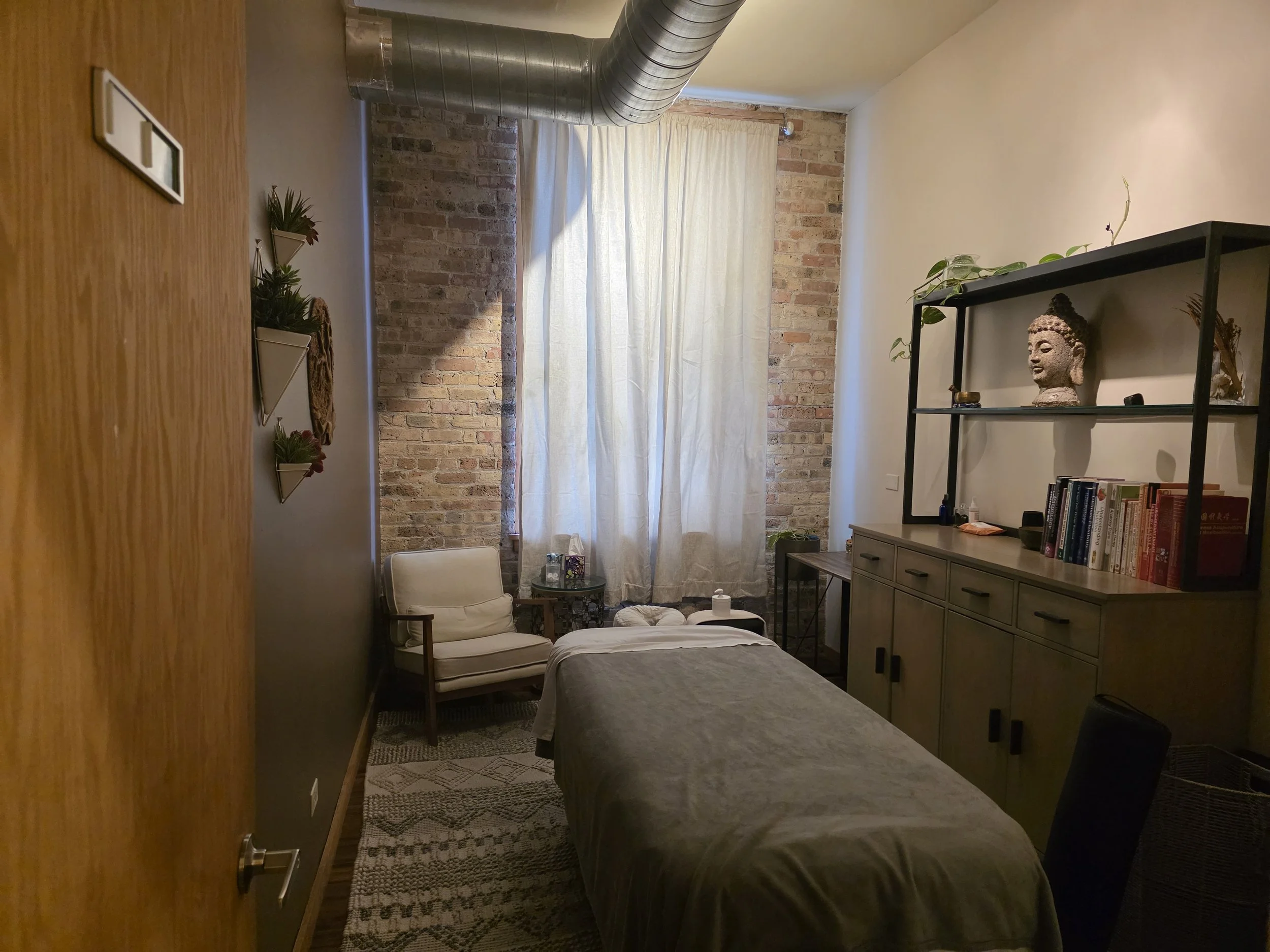
ARVAmethod Studio Chicago
A Client Story
She walked into my studio for the first time on a Tuesday. There was a subtle anxiety pulling at the muscle between her brows even as she smiled and shook my hand. "I'm really happy to be here," she said, with an exhale that carried more exhaustion than the words did. "Me too," I replied, slowing my own breath as I welcomed her in.
I began this session the way I begin all sessions, with one simple question that rarely has a simple answer. "So," I said. "How is your body?" She paused. She shrank a little. Then she sighed and said, "Where do I even begin.
She spoke about chronic gut issues, jaw pain, headaches, restless sleep, low back pain that came and went without explanation. She spoke about fertility concerns in her late thirties, and the fear she was holding that there was something more serious going on with her health and body that hadn’t been identified yet.
I listened to her words, and I listened to her body too. The breath sitting high and shallow in her chest. The sigh that kept arriving between sentences. Her shoulders lifted and rolled forward, as if bracing. Her eyes dropped to the floor when she said, "I’m just overwhelmed and haven’t found a real solution or answer." I let it land. I held the space for her to keep going, because that is always the first place we meet the body. With presence.
I'm thinking of one particular woman as I write this, but honestly, I could be describing many of the people who come through my door. So many of us struggle to connect with our own bodies, and struggle even more to put words to what we find when we try. The body holds everything. Somewhere along the way, most of us lost the ability to honor that.
What the Body Holds
The body processes life differently than the mind does. The mind works in language. It searches for words, builds a story, files each experience into a category, and tries to move on. The body works with something older and slower. Sensation. Breath. Posture. The particular way a person carries themselves into a room, into a relationship, into a conversation they'd rather not be having.
For most of us, the body absorbs more than it can fully process, and it never really stops taking more in. It keeps a full account. The tension that never quite releases. The breath that never drops all the way into the belly. The exhaustion that a full night of sleep doesn't resolve. The digestion that stays complicated, the relationship with food that stays fraught. What can feel like the body malfunctioning is often the body speaking in somatic language.
“The body holds what the mind has been too busy to process. And it holds everything until we learn how to let it go”
This is what I mean when I say the body holds everything. It is the accumulation of a whole life, one in which the body's intelligence is rarely recognized and almost never given the floor. The decisions made under pressure. The grief that never had a container. The rage that got dressed up as anxiety because that felt safer to carry. The longing that got set aside because something more urgent always seemed to be waiting. All of it lives in the body.
The woman who walked into my studio that day was full. Her body was holding an entire life, the relentless effort, the fear around fertility, the sense that time was slipping. And she had been holding most of it alone, because neither the culture around her nor the medical system she'd consulted had offered her a way to understand what her body was carrying as intelligence rather than failure.
This is what makes the real work of embodiment so much more serious than the wellness conversation tends to suggest. Coming back into the body, actually coming back, means reckoning with everything it has been holding.
How We Got Here
Disconnection from the body is a rational response to a world that demands output, rewards constant productivity, and punishes anyone who asks for time, space, or rest. The belief that the body exists to produce, perform, and comply runs deep and reaches far beyond any single generation or industry. It has shaped human bodies for a very long time, in ways both visible and hidden.
The hustle culture of my own generation gave this belief a fresh coat of paint. It repackaged extraction as personal virtue and gave it a clean aesthetic. Exhaustion became proof of seriousness. Overriding the body's signals became a marker of ambition. The body's intelligence, its capacity to say enough, not yet, something is wrong here, became something to manage rather than something worth listening to.
Digital life added another layer on top of that. It moved identity out of real world experience and into the curated image, the metrics, the performed self that exists somewhere between the screen and the audience watching it. Life became something to perform instead of live, and the intelligence of the body became increasingly beside the point when it came to how a person was seen, measured, or valued. What couldn't be captured, counted, or shared stopped seeming to count at all.
The result, for men and women both, is a particular kind of estrangement. Men are raised to treat the body as an instrument of strength and output. What the body feels, what it needs, what it knows, goes largely unexamined and aggressively discouraged. Women are asked to absorb the cost of that extraction in their nervous systems. The mental and emotional labor that falls so heavily on women doesn't stay contained in the mind. It settles into the body, and becomes a cascade of symptoms to manage on their own.
What we're living with now is the sum of all of it. Generations of people who learned, out of necessity, to live mostly from the neck up, treating the body's language as an inconvenience. And then when these people arrive at the inevitable season of real physical, emotional, and spiritual change, the body starts pushing back. It starts demanding the space it was never given.
The Aesthetic of Embodiment
The wellness industry has caught on to the fallout from all this disconnection. Embodiment is now a content category. Somatic awareness is now a selling point. The genuine, often desperate reach back toward the body meets a market that knows exactly how to package it.
And so we got the aesthetics of embodiment. Linen and candlelight. Beautifully lit breathwork sessions. The hushed language of nervous system regulation, delivered with the same visual polish as a luxury skincare campaign. The promise is that coming home to your body will “look” like ease, softness, a kind of glowing calm. Clean. Curated. Available by subscription.
While there is value in the turn toward embodiment, the aesthetic flattens what the return to the body actually is, and anyone who has walked through it honestly feels this immediately. It carries the same hollow energy as the perfectly curated life imagery of early social media, the kind we all eventually learned to see through as fake.
The real terrain is not always peaceful, and it rarely moves quickly. Coming back to the body after years of estrangement can be cathartic. It can arrive as grief. As rage. As the exhaustion of finally setting down what you've been carrying for far too long. It can be disorienting. The body starts speaking, and what it says doesn't always match the life that got built around its silence. Relationships shift. Priorities reorganize. Things that once felt essential start to feel hollow, and things that got dismissed start to feel relevant and important.
Sometimes it shakes your whole world. That isn't a side effect. That's the point.
The algorithm has no soma. No life cycle. No nervous system that has ever felt the cold, or got startled at a loud noise, or been moved by art, music, or the beauty of nature. It can recognize the pattern of embodiment language well enough to sell it back to you. But it has no access to the kind of wisdom that becomes possible when you actually live inside your whole life. That knowledge only lives in the body.
Embodiment moves slowly. It asks for space. It asks you for the very thing that productivity culture and aesthetic culture have spent decades training you to withhold; your full expression as a human being. That is why this work runs against the current. The aesthetic is the distraction. The reckoning is the actual work.
The Reckoning
I am a bodyworker. I landed on that title for myself after many years in practice. Movement, manual therapy, breathwork, lifestyle work with people arriving at a turning point. Most of the time, people find me because something in their health has shifted and they want to understand what their body is asking of them.
There comes a point for most of us when the body insists on a different kind of attention. Sleep changes. Energy shifts. Recovery slows. Weight redistributes. The nervous system that once absorbed everything without apparent cost begins to signal, again and again, that something needs to change. And alongside the physical, the interior life starts pressing forward too. The identities built in the first half of a life stop fitting quite the way they used to. Questions of meaning, purpose, and values surface in ways they never had before.
“The way forward begins with returning to the breath, to the body, to what has always been true. ”
What the Body Is Actually Asking
Our culture's response to this season of life is almost entirely organized around fixing something. Supplements. Optimization protocols. Hormone panels. Fitness programs. While these interventions are of great value, underneath all of them, the body is asking for something else entirely.
A different quality of relationship. One that most of us were never taught, and that wellness culture has rarely made real room for either. The willingness to listen. To sit with. To receive what the body needs as intelligence rather than inconvenience.
What I've come to see in twenty years of this work is that the disruption a body produces at this stage of life opens something no other phase quite reaches. Sleep that breaks down is often a system asking for a deeper kind of rest, the kind that only becomes available once we let go of what we no longer need to carry. A gut that won't settle is often asking for the kind of nourishment that becomes possible once we stop negotiating with our own basic needs. Weight that redistributes often reflects a hormonal architecture that is simply shifting, moving away from the pressure to perform and toward the need to feel well, and maybe even to take up more space in the world.
This is a body holding a whole life while moving into a new season of being, asking for the time and space to finally find some ease. Underneath the symptoms, underneath the diagnostic, underneath the search for what's wrong, the question is really simpler than it seems:
“What have you been carrying all these years? And are you ready, finally, to set it down?”
The Return
Centering the body is an orientation. A decision made over and over, to treat the body's intelligence as worthy of the same attention you've given everything else in your life.
In practice, it begins exactly where that session began. With presence. With an honest question about your body has been holding. And with the willingness to slow down long enough to actually hear the answer.
I think about her often, the woman who walked in on a Tuesday, who sat down across from me and didn't know where to begin. What she needed in that moment was someone willing to slow down with her. To make room for what she was carrying. To let it land in the body and finally be felt.
That is always where it begins.
So before you move on to the next thing, pause.
Take a breath.
Give yourself one moment simply to be.
If you’re curious about how your unconscious patterns are landing in your body, the ARVAmethod Living Archetypes is a framework built to help you find solid ground — holding yourself with greater awareness and compassion as you move into the next half of life.
